
Applicants
Dr. Alberto Leonardi
Prof. Thorsten Pöschel
Institute for Multiscale Simulation
Friedrich-Alexander-Universität Erlangen-Nürnberg
Project Summary
The aim of the “STAR-MiSt” project was to develop an open-source library for efficiently and
accurately solving the Debye Scattering Equation (DSE) based on the Rose-X code (A. Leonardi,
D. L. Bish, JACr 49 (2016) 1593). The DSE is crucial for analyzing powder total scattering data,
but traditional brute-force or binning-based algorithms suffer from numerical approximations
that compromise accuracy.
The Rose-X algorithm addresses this issue by offering computational efficiency and high
accuracy. Building on this foundation, the KONWIHR Project introduces an improved iteration
called AES-Debye (Accurate, Efficient, and Scalable Solution of the Debye Scattering
Equation). AES-Debye’s robustness in handling systems with significant atomic position noise
opens new possibilities for extracting meaningful insights from highly disordered materials. The
code leverages a combination of OpenMP, MPI, and CUDA programming paradigms to
maximize local hardware configurations. Heuristic benchmarks dynamically set various
implementation parameters, ensuring optimal performance across diverse hardware
environments. The open-source implementation is made available on GitHub, with a Python
binding and a LAMMPS plugin to facilitate integration into existing workflows.
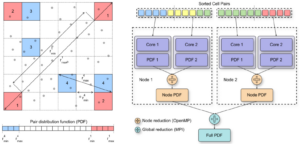
Through rigorous performance optimizations and strategic domain decomposition to optimize
memory access operations, AES-Debye achieves a 20-fold speedup over the Rose-X
implementation. Since DSE calculation requires PDF calculation first, the same code can also be
used to calculate PDFs for other applications requiring a large number of bins or high numerical
accuracy.
References
Navid Panchi; Sebastian Kuckuk; Markus Wittmann; Michael Engel; Alberto Leonardi. AES-Debye: Accurate, Efficient and Scalable Solution of the Debye Scattering Equation. IUCrJ 2025